
Priority Places
for Species at Risk
Canada’s biodiversity is a cornerstone of our way of life. As human impact on the planet grows, more habitat is lost and more species are at risk of extinction.
We need to take innovative action to protect and recover the animals, plants, and places we love.
Focusing our effort in specific locations with high biodiversity and concentrations of Species at Risk helps us conserve habitat that benefits many species at the same time. It also allows us to bring together partners with common goals to improve collaboration and coordination.
Through partnership, we will work to achieve sustainable protection and recovery of Species at Risk.
In the 2018 Budget, the Government of Canada invested a historic $1.35 billion to reach the biodiversity goals of protecting a quarter of its lands and a quarter of its oceans by 2025, to create healthier habitats for Species at Risk, and to improve its natural environment.
In each priority place, the federal and provincial or territorial governments will collaborate with partners to develop and implement a conservation action plan coordinating actions to address the greatest threats to Species at Risk.
Such actions include habitat stewardship, habitat restoration, and education and outreach.
There are now 12 priority places identified under the Pan-Canadian Approach to Transforming Species at Risk Conservation in Canada. This new approach shifts from a single-species approach to conservation to one that focuses on multiple species and ecosystems. We are concentrating our conservation efforts on priority places, species, sectors and threats across Canada.
The priority places selected have significant biodiversity, high concentrations of Species at Risk, and opportunities to advance conservation efforts. Each priority place has a common ecological theme. They cover nearly 30 million hectares, including 2 million hectares of critical habitat for Species at Risk. More than 300 Species at Risk can be found in these places, many of which have more than half of their range in a priority place. These priority places are complemented by a suite of Community-Nominated Priority Places that were identified through an open call for applications.
We recognize the importance of the Indigenous lands that we are calling priority places. We acknowledge the ancestral, unceded, and treaty lands of all Indigenous Peoples that call these lands home. Through this acknowledgement it is our intent to show respect for the people who have stewarded these lands and waters since time immemorial and those who continue to care for them. We do this to reaffirm our commitment to learn and work together in the spirit of reconciliation.
To learn more on all 12 Priority places across Canada, click here.
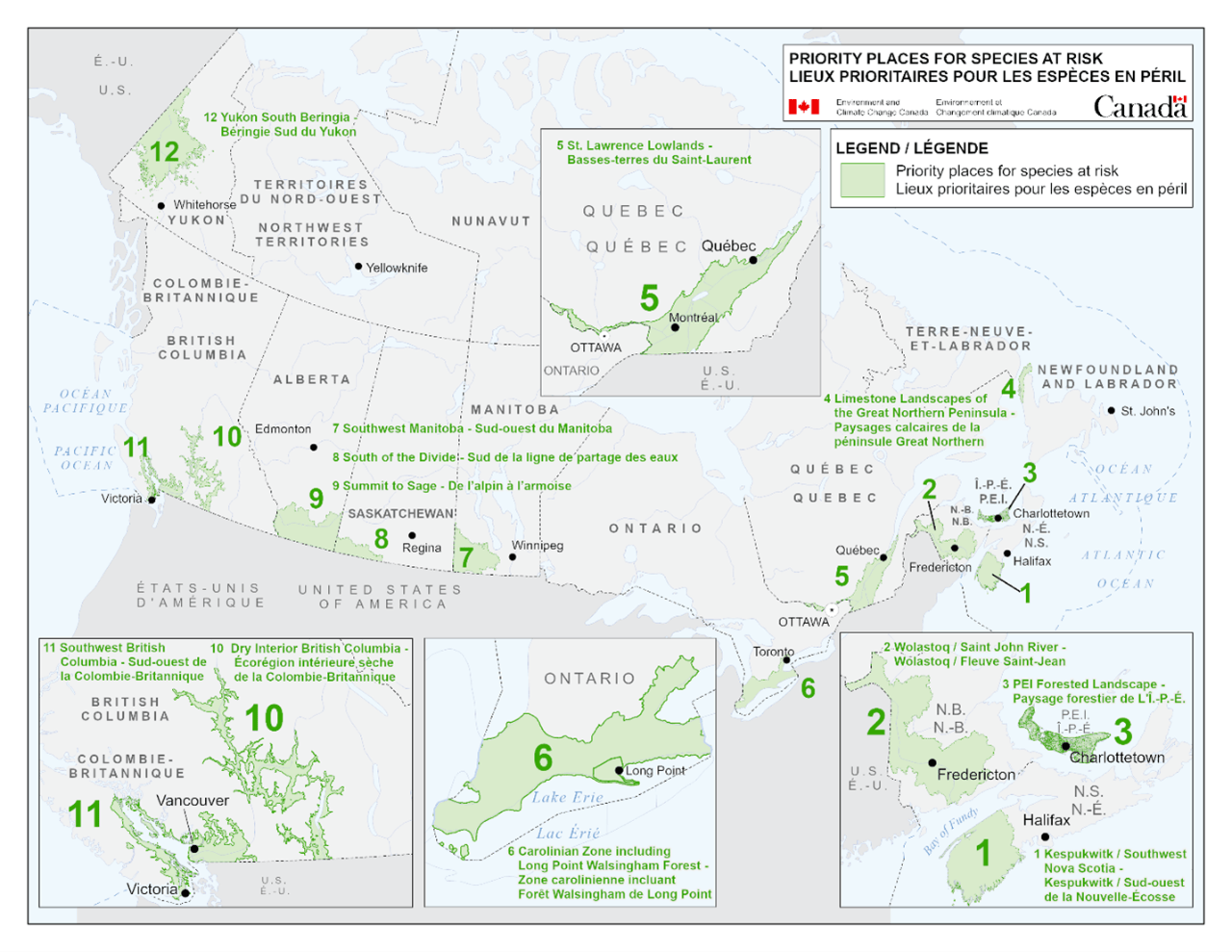
Having a designation as a Priority Place spurs the co-investment and development of an action plan for Species at Risk conservation, led by agreed principles and common criteria for local priorities and partnerships.
Working together to conserve Species at Risk in the Wolastoq / Saint John River Priority Place